


Net zero in 2040
Ambitious plans require concrete targets. That is why we link figures and target years to our sustainability approach. This allows us to clearly see whether we are on track. And it allows you to do the same.
We aim to have reduced our CO₂ emissions by 45% by 2030. And by 2040, we want to be net zero. By then, we will have reduced our CO₂ emissions by 90%. This means that we will have almost no negative impact on the climate.
Our approach

Climate
We want to minimise our impact on the climate as much as possible. Not only during the last mile to your doorstep, but throughout the entire journey of your parcels. In doing so, we contribute to the goals of the Paris Climate Agreement.

Liveability
We are aware of the impact our activities have on your local environment. That is why we aim to deliver parcels with as little impact as possible on the living environment, while protecting nature and the environment as much as possible.

Circularity
In a sustainable society, we need to use resources more responsibly. That means reducing waste and increasing reuse and recycling. We aim to play an important role in the transition to a circular economy.
Our progress
- 1
CO₂ emissions per delivery option
Average CO₂ emissions per parcel amount to 324 grams for home delivery and 250 grams for delivery to a pickup point. The largest share of these emissions occurs during the last-mile phase, the journey from our depots to the consumer.

- 2
Electric vans and cargo bikes
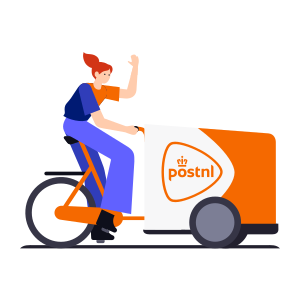
In 2025, 8% of our last-mile kilometres were completed entirely emissionfree. In total, 30% of our deliveries were carried out using electric vans and cargo bikes. This share continues to grow every day.
- 3
First-attempt delivery success
We successfully deliver a parcel on the first attempt in 97% of cases. This represents a 1% improvement compared to 2024 and contributes to a more efficient and sustainable delivery process.

- 4
Renewable energy
Two-thirds of the energy consumed in our buildings comes from renewable sources: locally generated solar energy from rooftop solar panels and green electricity from North Sea wind farms. The remaining energy consumption is covered by gas heating.

- 5
Evolution of CO₂ emissions
CO₂ emissions per parcel were more than 10% higher in 2025 than in 2024. This increase is primarily explained by a higher number of deliveries in rural areas, where zero-emission delivery remains more challenging due to the limited range of vehicles. In addition, part of the increase results from an enhanced measurement methodology, enabling us to capture emissions more comprehensively and accurately.

Together we can reduce CO₂ emissions
We remain committed to further electrifying and optimizing our network to structurally reduce emissions. Consumers also play an important role: they decide how they collect their parcel. When parcels are collected on foot, by bicycle, by electric vehicle, or during another trip such as grocery shopping or commuting, no additional emissions are generated. Together, we can make a difference.
How is our approach assessed?
Our sustainability policy and results are independently assessed every year. We consistently achieve strong scores in benchmarks covering people, the environment and governance. Below, you can find some of our certifications and benchmark ratings, or visit the page with a complete overview of our measurable results.

Dow Jones Sustainability Index
The Dow Jones Sustainability Index (DJSI) assesses companies worldwide based on economic, social and environmental criteria. In December 2025, PostNL ranked fifth overall. This places us among the top 2% of all participating companies and makes us the highest-ranked logistics e-commerce company in the world.

Carbon Disclosure Project
Every year, we share our initiatives and achievements aimed at reducing our environmental impact with the Carbon Disclosure Project (CDP). Since 2022, we have been included in its A List, which recognises organisations that demonstrate the strongest commitment to tackling climate change.

EcoVadis Sustainability Rating
EcoVadis is an organisation that assesses companies on their corporate social responsibility (CSR) performance. It evaluates areas such as environmental policies, labour and human rights practices, business ethics and sustainable procurement. According to EcoVadis, we rank among the top 1% of companies in our sector.

“I believe it is important that we take meaningful action for people and the environment. Sustainability is fully embedded in our business strategy. We set ambitious goals and communicate transparently about our progress and results.”
Pim Berendsen, CEO of PostNL
What else we do for society

Charitable organisations
Together with charities and social organisations, PostNL works to strengthen connections within society. In doing so, we provide meaningful support to people who need it most.

Responsible employer
Sustainability goes beyond environmental impact. We also care about people and society. That is why we strive to be a responsible employer for everyone who works with us and for us. Curious to learn how we do this?